A preparation-and-deployment MMORPG. Mix any weapon, any skill, any doctrine, then deploy your operative into a kingdom the wicked have ruled for thousands of years.
A preparation-and-deployment MMORPG. You author the operative's equipment, skills, spells, items, and the conditions under which each one fires. Then you deploy them into the dungeon with no live input. What you prepared is what they do. Every other system in the game exists to serve that loop.
Fourteen mastery tracks covering every weapon family, every armour class, both magic schools, and every utility skill. Each levels through use, each capped at your character level. Specialise in a few to hit max fast, or grind every track for a true generalist build over a much longer arc.
Three deployment postures. Assault is for full confrontation. Infiltrate rewards builds that specialise in stealth. Ghost is for information gathering, undetected, with no combat permitted.
Skills, spells, and items each configured with seven sections of conditional logic. Prepare the operative to react when specific situations arise, including knowledge-gated triggers that fire only against threats you've learned to expect.
Twelve mission categories. Rescue, Assassination, Sabotage, Liberation, Extermination, Intelligence, and the rest, across fifty-one stages from Level 1 through Level 100.
A working combat engine, verified end-to-end through Level 100. The dungeon log on the Combat Log page is the raw output. The math runs; the wrapper above it is what your pledge completes.
Time, never power. No gacha, no loot boxes, no stat advantages sold for money. Free players reach the endgame; Premium removes grind friction only.
What Makes It Different
These are not features in the sense of items on a list. They are decisions the project made early and has held to, and each one shapes the game in ways the reader will encounter in every other section of this page.
Deployment Environment
The dungeon is a flat-top hex grid, six to fourteen columns deep. Movement, attacks, and skills cost Action Points. Combat is positional and deterministic; the operative resolves every step against the engine's exact stats, using the equipment and configuration you set before they left. The environment does not bend.
Fourteen independent masteries
Fourteen disciplines, each capped at the character's level, each levelling at its own pace through use. The mastery curve forces specialisation: a character cannot be excellent at every weapon, every armour set, every magic school, and every utility skill all at once.
Stealth as a complete playstyle
Three deployment postures, of which Ghost permits no combat at all and Infiltrate rewards silent kills with the Dagger or the Bow. Stealth is not a passive bonus or a status effect; it is a way of running the entire dungeon, with its own rules for failure and its own ceiling for reward.
Configuration that runs unsupervised
Every skill, every spell, and every consumable carries seven sections of conditional logic the player sets before deployment. The operative is not a script; the operative is an instrument carrying out the player's doctrine, including knowledge-gated rules that fire only against threats the player has learned, through reconnaissance or through fighting, to expect.
Time, never power
The Premium subscription buys convenience, never advantage. There are no gacha boxes, there is no exclusive content, and a free player who reaches the endgame has reached every dungeon and every mastery a paying player has.
A combat engine that already runs
The combat engine is a working Python build, verified through Level 100 across formulas, status effects, stealth detection, traps, and all fourteen masteries. The final debugging pass and the wizard above it (the surface that hands the player's authored doctrine to the engine) are what the campaign funds.
How You Play
Veins of Aldûn is a preparation-and-deployment MMORPG. The player does not pilot the run; the player prepares it. The character will execute that preparation faithfully and at length, and what unfolds in the dungeon will be the consequence of what was decided before it. The deployment wizard, then, is where the game is played.
What follows is the wizard as it stands in the current build, six screens in order. The screens are working mockups; visual polish and backend wiring are the work this campaign funds.
Screen 1: Dungeon Detail
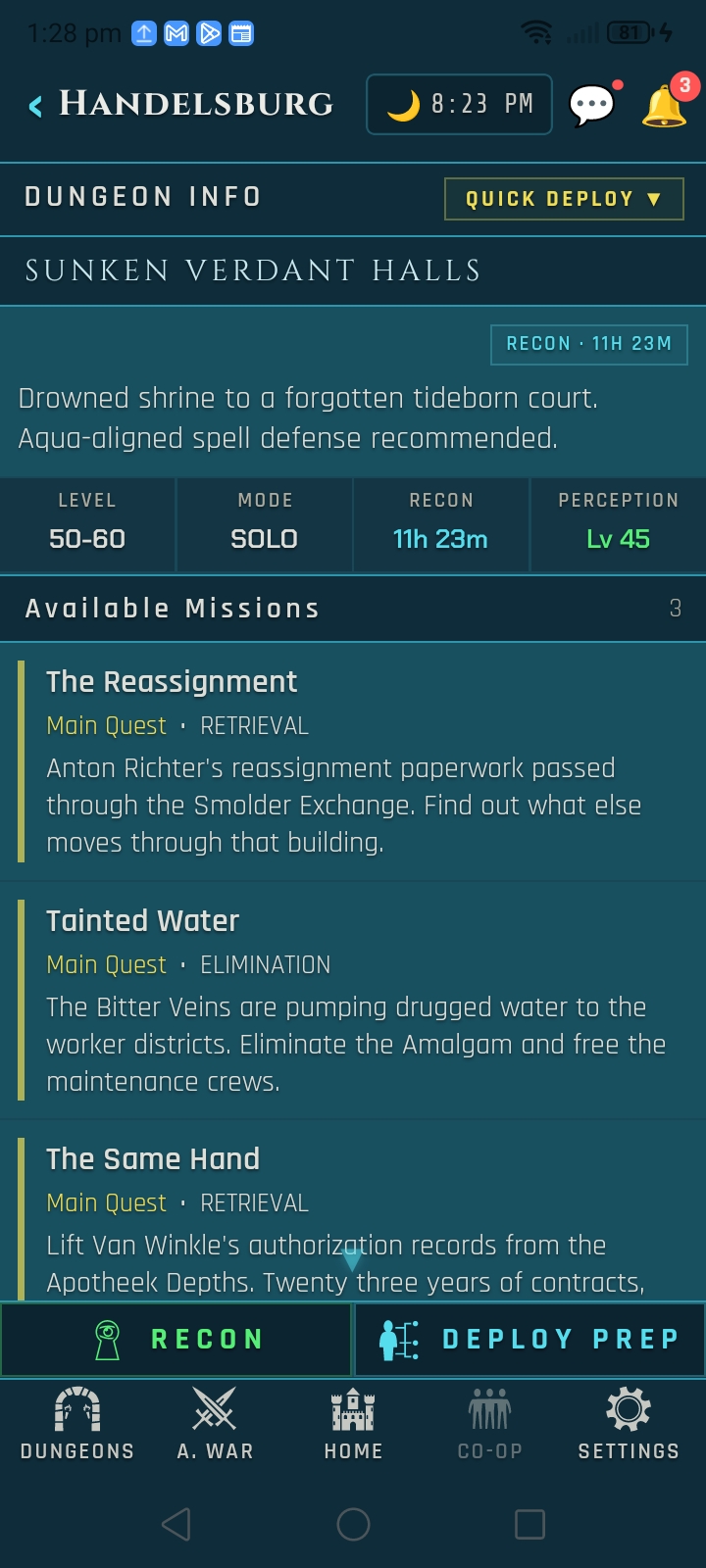
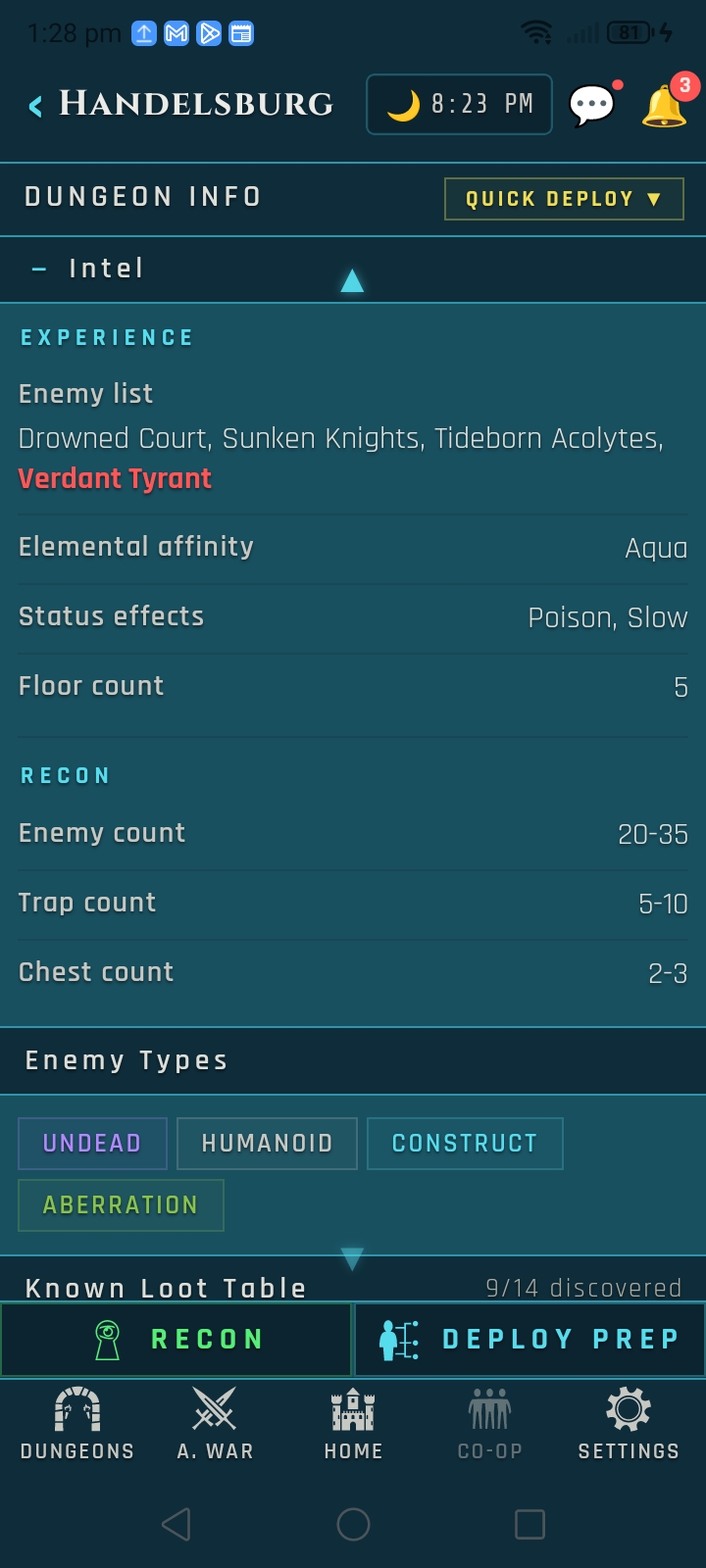
Before the operative is sent anywhere, the player needs to know what they are sending them into. This screen answers that question. It gathers, in one view, the dungeon's name and level band, the floors it contains, the missions tied to it, the stats it recommends, and the loot the character has already drawn from it. An Intel drawer expands for the full pre-entry picture, or stays collapsed when the player only wants a glance.
What is in that Intel drawer comes from two sources. The first is gameplay discovery, the permanent record of every enemy this character has faced in this dungeon, every boss they have stood across from, every drop they have pulled from it. Knowledge earned this way persists. It does not need to be relearned. The second is RECON, a scouting operation the operative may run before deployment, gated by Perception Mastery and refreshed on a twelve-hour cooldown. A character of Perception 1 returns from RECON with the threat level alone. A character of Perception 95 can map nearly the entire dungeon through repeated reconnaissance in the same window: enemy counts, trap locations, chest tiers, boss abilities, status immunities, anti-stealth conditions. Reconnaissance scales with investment.
From this screen the player may withdraw, enter RECON, enter the prep flow, or use Quick Deploy to re-use the last committed loadout for this dungeon and skip straight to the Briefing.
Screen 2: Mission Select
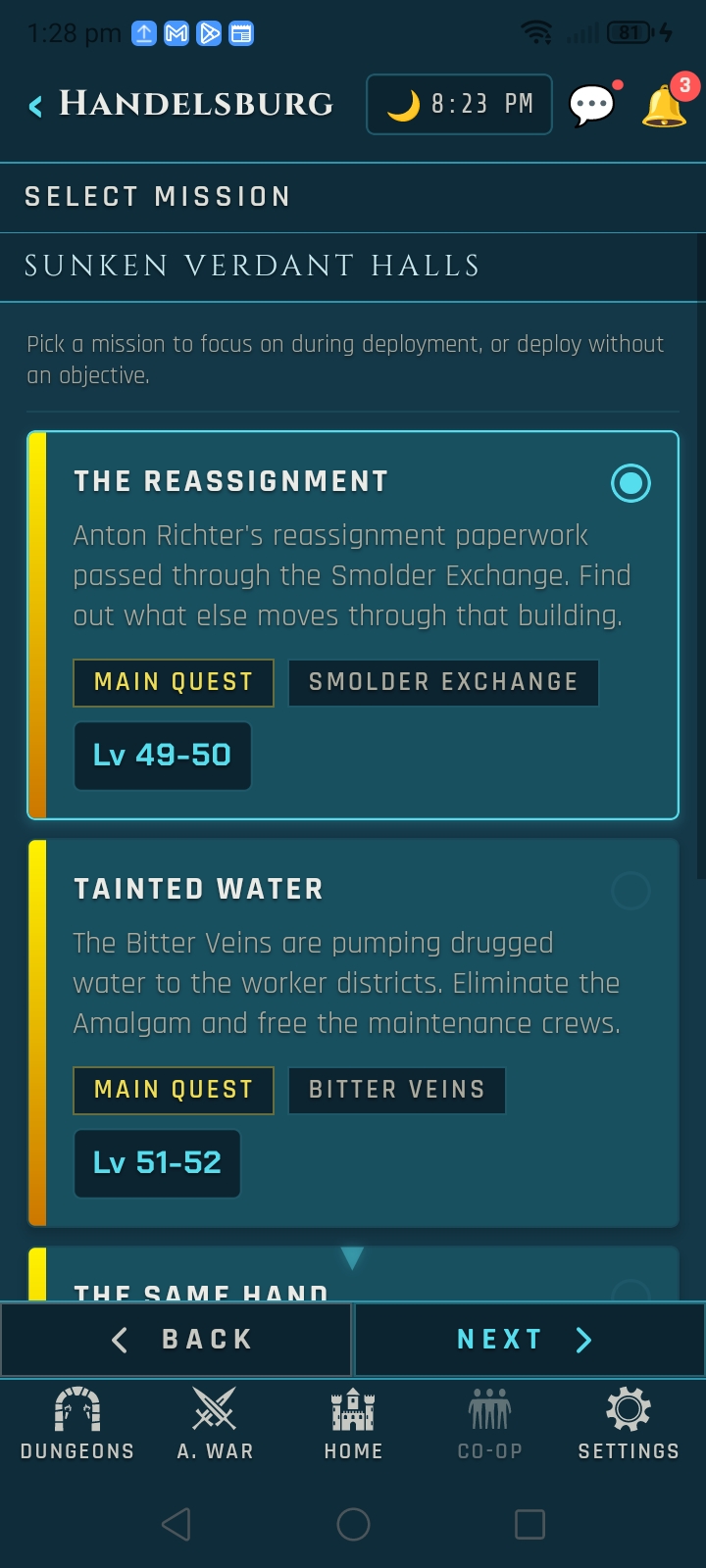
Each dungeon may carry several missions, drawn from the Notice Boards of the settlements that surround it. The Order's catalogue runs to twelve categories: Rescue, Assassination, Theft, Sabotage, Intelligence, Intercept, Purification, Prevention, Liberation, Extermination, Retrieval, and Elimination. On this screen the player selects one of the missions available for this dungeon, or chooses to deploy without one. The latter is the proper choice for a player whose business in the dungeon is loot, experience, or mastery practice rather than an assignment of record.
Screen 3: Deployment Type
Three postures are available to the operative inside a dungeon, and the choice between them shapes everything that follows. It decides what kind of work the operative is asked to do, what their body will spend in doing it, and what counts as failure.
Assault is the open posture. The operative enters each floor in the open, every enemy aware of them from the moment they step inside, and clears the floor through combat. The cost is twenty fatigue. The reward is the standard share. Nothing about an Assault deployment is hidden, and nothing about it is graceful.
Infiltrate is the mixed posture. The operative enters each floor in stealth and may take silent kills with the silent weapons, the Dagger or the Bow, for as long as they remain unseen. A failed stealth check or a noisy kill ends the silence for the rest of that floor; combat begins, and the next floor returns the operative to stealth to begin again. The cost is thirty-five fatigue, more than either of the others. The reward, for those who can stay quiet, is correspondingly higher.
Ghost is the absolute posture. The operative enters in stealth and stays in stealth for the entirety of the run. No kills are permitted. No floor is cleared; every floor is bypassed. A single failure to remain undetected, whether a missed stealth check or a triggered trap, ends the deployment regardless of how close to the exit the operative had come. The cost is ten fatigue, the lowest of the three. The reward, on success, is the highest. Two mission categories, Extermination and Liberation, are incompatible with Ghost by definition, and the wizard disables the option for them.
These are not three equivalent settings. They are three different agreements the operative makes with the dungeon, and each agreement shapes the loadout that will be right, the skills that will fire, and the cadence of the run that follows.
Screen 4: Combat Behaviour
A configured skill fires only when its conditions are met, and a configured item only when the player has prepared it to. In between those firings, the operative needs a standing rule for whom to prioritise in a crowd of enemies and where to stand when the fighting starts. This screen sets that rule.
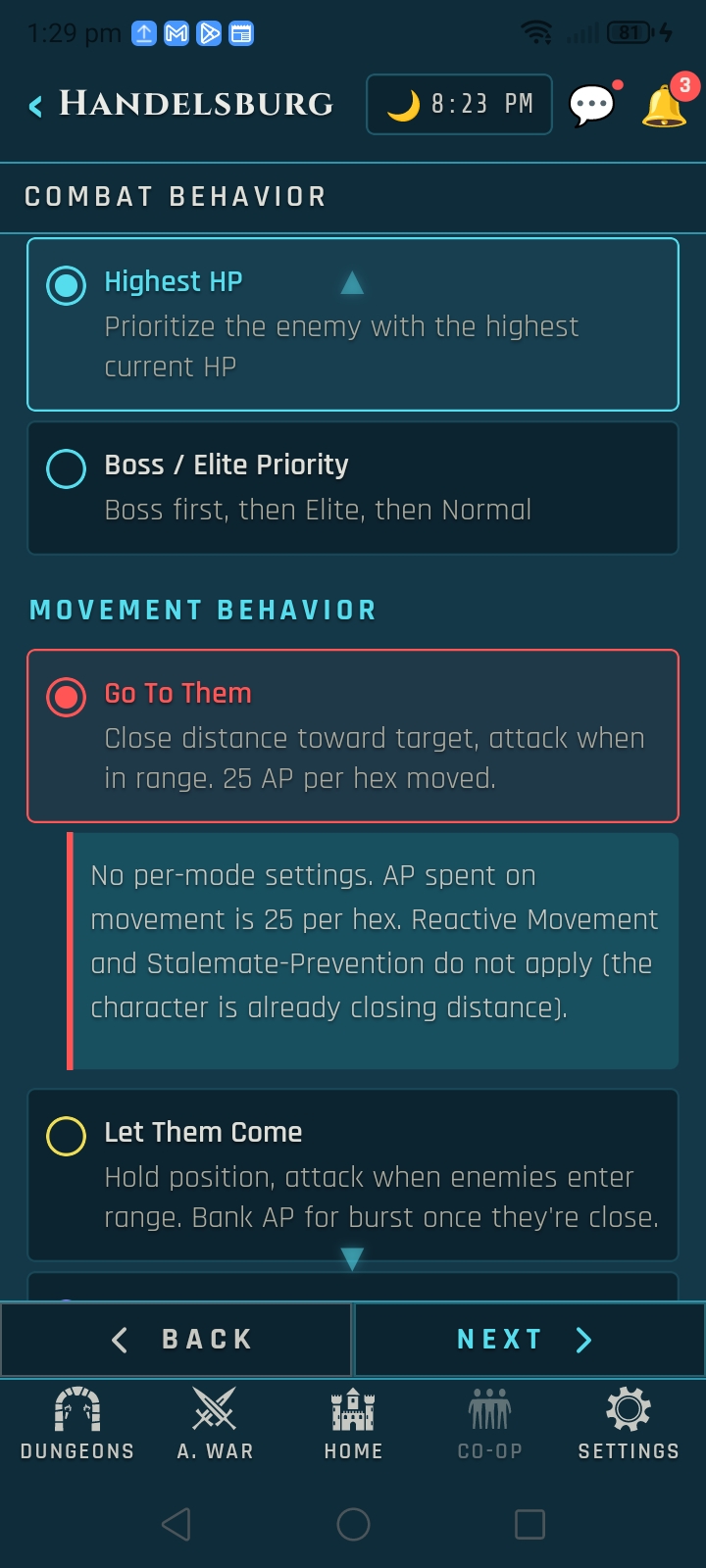
Target Selection is the operative's standing answer to the question of who to fight first. The list runs to several modes: Attack Nearest, Attack Furthest, Highest HP, Boss/Elite Priority, and others. Each is a different reading of what first should mean across an engagement.
Movement Behaviour is the standing answer to where the operative wants to be when the fight comes to them. Three modes are available. Go To Them closes distance toward the chosen target and engages on contact, twenty-five Action Points per hex of approach. Let Them Come holds position; the operative banks Action Points while waiting, up to a cap of two hundred, and unloads when enemies finally enter weapon range. A character attacked from outside their range under this mode will reposition once toward the attacker, then resume holding. Stay Away is a kiting discipline: retreat from melee threats inside a configurable range, hold and attack when enemies sit within weapon range, hold and wait when enemies are still approaching, advance to weapon range only when no enemy is in range and none is coming.
Together these two dials describe a posture. Attack Nearest paired with Go To Them is the aggressive rush of a one-handed melee operative. Attack Nearest with Let Them Come is the defensive stance of a Greatsword counter-attacker. Attack Furthest with Stay Away is the true ranged build of a Bow specialist who refuses to give ground. The combinations describe a wide range of distinct playstyles, and they govern every moment between skill activations.
A Ghost deployment skips this screen entirely. With no combat permitted, there is no combat behaviour to configure.
Screen 5: Mission Preparation
This is the screen on which the operative's tools and tactics are written. It carries three tabs: one for the equipment they will be wearing, one for the abilities they will be drawing on, one for the items they will be carrying. Each tab is its own act of preparation, and each accepts the same scrutiny.
Gear holds thirteen equipment slots, weapon and armour and accessories together, every slot showing the equipped item, its tier, its reinforcement level, and its current durability. Stats recompute on every swap, so the consequence of replacing a sword or changing a shield is visible the moment the player makes it.
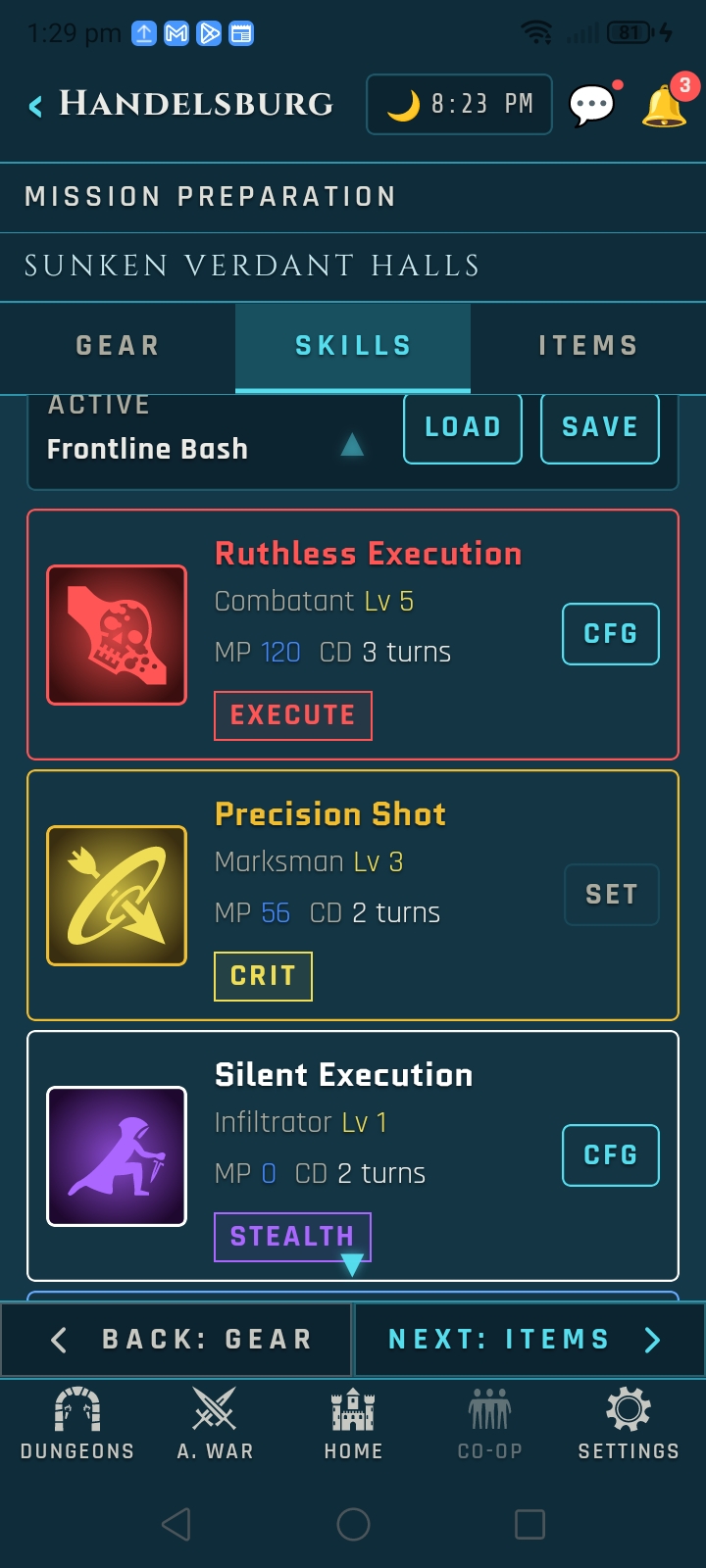
Skills holds five Skill/Spell slots, shared between the character's skills and their spells. Each slot accepts not only a chosen ability but a Skill Usage Configuration, opened from the slot's CFG control. The configuration runs to seven sections: which targets are eligible, what resource state the operative must be in, what status conditions must hold, what combat-state triggers are required, what the surrounding encounter must look like, what skill-specific options apply, and how often the skill is permitted to fire. A configured skill fires when, and only when, every section's conditions are met. Five well-configured skills, set against a hundred different rooms, produce a hundred different combat logs.
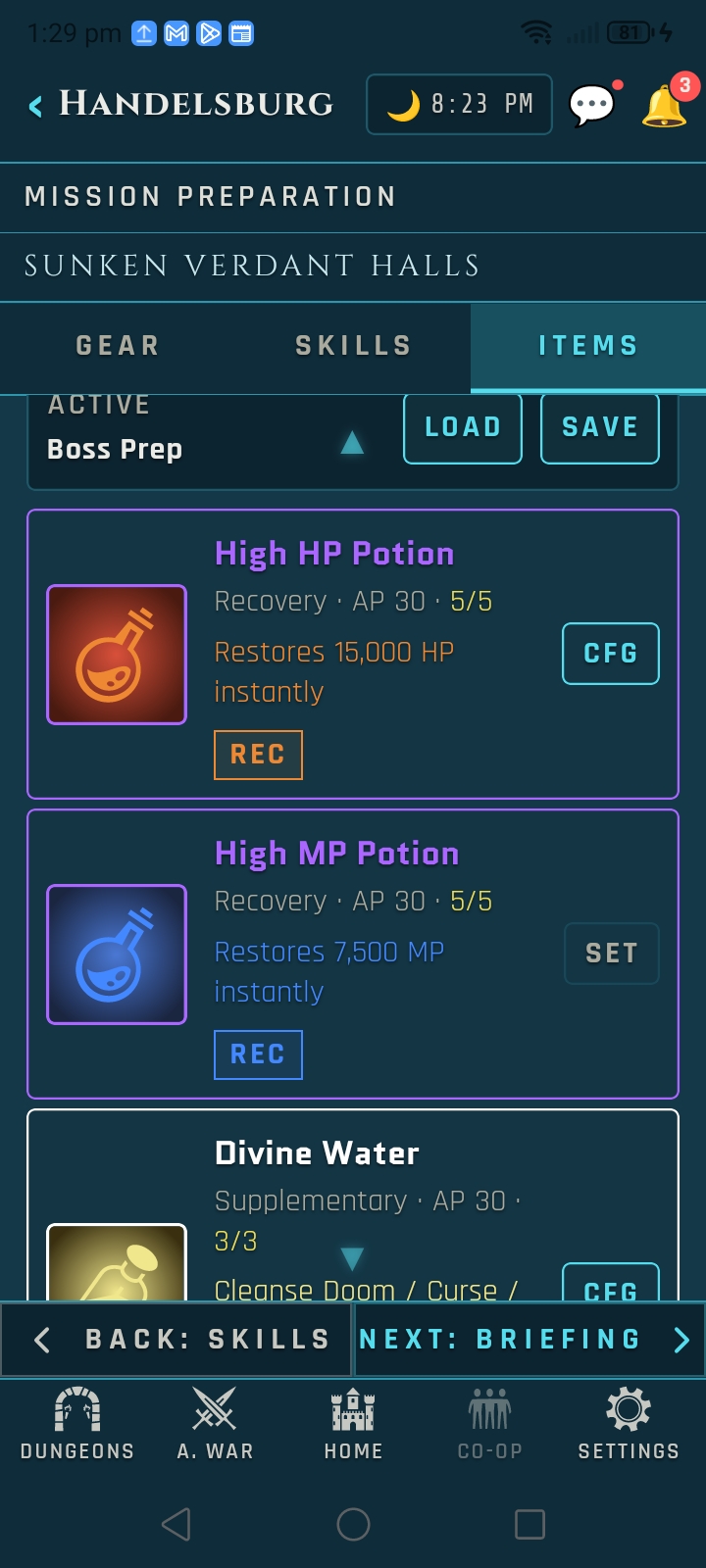
Items holds three to six consumable slots, depending on character level, divided among the three roles: Recovery, Utility, and Supplementary. Each slot accepts a consumable and its Item Usage Configuration, reached the same way as a skill's. The configuration mirrors the Skill Usage Configuration (SSUC) in form, but the trigger families it supports are unique to it. Reactive triggers fire when a state is observed (HP below threshold, status applied) and are perfectly precise, but they can lose the race to a killing blow. Proactive triggers fire on structural cues such as the start of combat or the entry to a new floor, and guarantee the consumable is in effect before the threat lands. Knowledge-gated triggers, the most sophisticated of the three, fire preemptively only when the player has discovered, through RECON or through direct experience, that the room contains a threat the consumable can answer. The curative configured this way will not waste a charge on a room with nothing to cure. It will spend no charge until the player has earned the right to spend one.
Each tab supports named loadouts that can be saved and loaded as templates. A melee gear set named Tyrant's Wrath. A skill set named Frontline Bash. An item set named Boss Prep. The labels become the player's library; the templates become the player's instinct.
Below the tabs, a live Key Stats strip recomputes on every change, and a Warnings strip surfaces what the configuration is doing wrong: a broken item, a missing potion, a stealth rating mismatched against a Ghost deployment, a character level below the dungeon's minimum. The game does not stop the player from deploying with a loadout they have deliberately chosen, even a risky one. It does ensure they cannot deploy without knowing what they are choosing, and it will block a commit outright if the loadout has become invalid between preparation and briefing.
Screen 6: Mission Briefing
The final screen is a contract, and the player is asked to read it. Every decision from the first five screens is listed in summary: the mission, the dungeon, the deployment, the behaviour, the loadout, the expected stats, and the fatigue that will be spent for the right to attempt the work. Any value listed can still be amended; the player taps the corresponding EDIT control, routes back to the screen that owns the decision, and returns here when they are satisfied.
The screen also asks one new question, and only one. Whether to depart now, or after waiting for the day, or after waiting for the night. Day and night affect a handful of detection ratings and a small number of enemy behaviours, and the choice is the player's last before they commit to the dungeon.
When they do commit, the fatigue is deducted, the snapshot is sealed, and the operative is sent into the field. No further input is possible until the mission resolves.
And then you watch
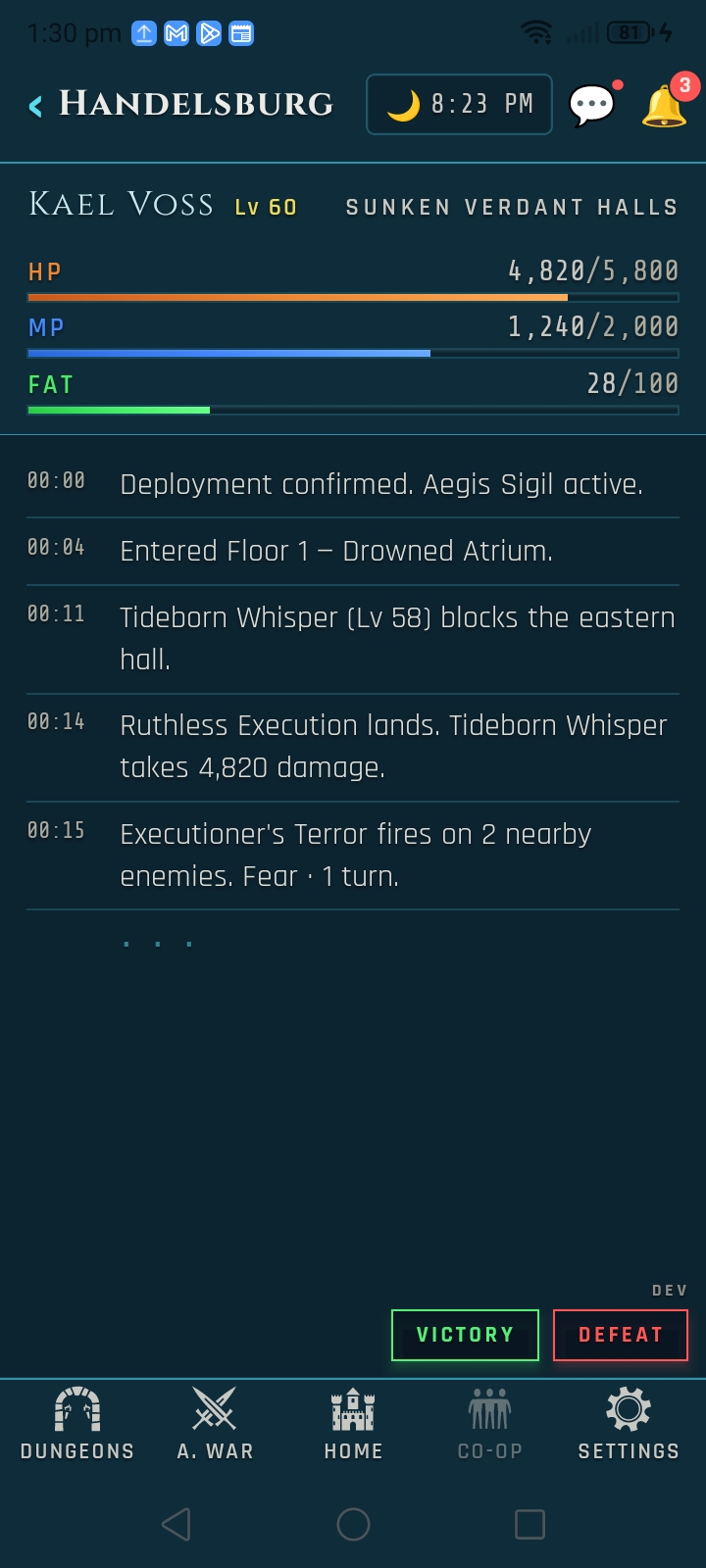
What follows the commit is no longer the player's. The combat engine takes the doctrine and the loadout and the postures the player has written, and it plays them out on a hex grid. The log streams the operative's vitals, the floors entered, the skills fired, the damage dealt and taken, the crowd control applied. The player can spectate the run. The player can also close the application and return when it is finished.
The combat log above is the mobile presentation of a deployment in progress. What writes those entries is the working Dungeon Tester, the same engine that already resolves every fight in this game and that will resolve every run on launch. The math runs end-to-end through Level 100 today; the final debugging pass on the engine and a clean-up of the log itself are part of what your pledge completes, alongside the wizard that hands the player's authored doctrine to it. The narration that streams the events to you (the dramatic relay of an operative's run, distinct from the upfront log shown here) is also work the campaign funds.
MMORPG
Outside the dungeon, the game is an MMORPG. What you find on a run is the start of an investment loop. The Alliance you join turns solo work into territory. Four-player co-op runs harder versions of every dungeon you already know.
Your gear compounds
Every weapon, armour piece, and accessory drops in one of three tiers: Normal, Premium, or Special. The tier sets the ceiling on what the item can become; the rest of the ceiling you earn yourself.
Dismantle the pieces you don't want into smithing materials. Spend those materials to reinforce a chosen item from +1 through +15. Each level adds 7% to every primary stat on the piece, reaching a 2.05× multiplier at +15. Reinforcement carries real risk past +4, where a failed roll loses levels, and past +10, where a roll can destroy the item outright. Once reinforced, enhance the piece with a Divine Sliver to permanently lock in one stat at +20% to +100%: no risk, always succeeds, but Divine Slivers are scarce. The endgame loadout is months of compound investment, not a single perfect drop. See the equipment families▸
Alliances
Alliances are persistent player groups, fifty to one hundred and fifty strong, with a twenty-rank progression the membership levels collectively through pooled treasury contributions and shared dungeon runs. Members donate gold; the Alliance accrues rank; rank unlocks territory bonuses that apply to every member's solo and group runs.
At Rank 20, an Alliance earns +50% gold and +50% skill progression on every stage it holds: a reward designed for groups that play together for months, not a week. Officers manage roster, deposits, and the defenders who will face rival assaults when wars are scheduled. Joining an Alliance is optional; the solo loop never depends on it. But the higher you climb, the more the social layer becomes its own progression.
Territory Wars
On three nights each week (Wednesday, Friday, and Saturday), Alliances assemble for two one-hour war windows. Unclaimed dungeons fall to the first Alliance whose member clears them. Claimed dungeons are defended in tiered 1v1 matches: the holding Alliance fields three defenders (Vanguard, Main Battle, Rearguard); the challenger fields three attackers. Win all three matches and the territory transfers. Lose one and the holder keeps it.
Higher-stage holdings stack their bonuses down the entire level ladder beneath them, which means a Stage 51 territory is worth substantially more than a Stage 7 territory. Alliances will spend months coordinating to take the late-stage dungeons and longer still to keep them. The schedule is fixed and the windows are short; the planning happens between them.
Four-player co-op
Post-launch, harder versions of every existing dungeon will support four-player co-op runs, deployed simultaneously against the same enemies. Loot rolls per player with no need/greed bidding; every party member earns full gold and rolls their own drops independently. The dungeon scales up to match four operatives (enemies tougher, bosses tougher still), so the four-player room is a meaningfully harder fight than a solo run, with proportional rewards.
Co-op is an Alliance-friendly addition to the same dungeon catalogue rather than a parallel content tier: you take the dungeons you already know to harder difficulties, with a party of three friends or allies. Ghost deployments and RECON remain solo; the rest of the catalogue opens up.
The claim that the combat engine already runs is not decoration. The screenshot below is one turn of a real Level 30 deployment, resolved by the Dungeon Tester: the Python build of the combat engine that has been clearing dungeons to Level 100 since long before this campaign existed.
What you're looking at: the Item Usage Configuration auto-applies a Low HP Potion, three Skill Usage Configuration slots are evaluated against the current combat state, slot 3 fires Vaulting Tombstone, an enemy counter-attack is blocked, and Looming Consequence counter-bashes. Every line below the cast is the engine showing its work: attack overrides, damage multipliers, defence values, the physical-damage formula resolving line by line. The full run, all eighteen thousand lines of it, lives on its own page.
After decades of historical, magical, scientific, and alchemical inquiry, 34 scholars from across the three continents of Alvasmere uncovered the first concrete evidence of the supernatural being responsible for creation. Drawn together by fate and faith, their combined knowledge, along with divine providence, revealed the truth of the world, and the reason the evils within it have thrived for so long.
What came before
For thirteen epochs the peoples of Alvasmere had built kingdoms, founded religions, and recorded their interpretations of every wonder and every catastrophe their continent produced. Each tradition had observed truly. The Sixfold Truth of Korveth, the Morvain Orthodox Harmony, the Desert Trinity of Lahadbamahim, and the smaller faiths beneath them all held fragments of what their faithful had witnessed. None of them held the whole.
The 34 scholars who would later constitute the Order began as historians, naturalists, astronomers, alchemists, and theurges, each working from their own discipline and within their own corner of the continent. None of them, working alone, could assemble what they had found.
The Calling
The means of their coming together were not arranged by any one of them.
In the years leading to the gathering, the heavens performed an alignment of stars unlike any in the records of established astronomy. The alignment was visible to anyone who cared to look; what no ordinary scholar could do was read what it pointed to. Reading it required the work each of the thirty-four had been doing, separately, in their own disciplines, for decades. Only by the consistency of what their studies had each returned could the alignment be deciphered as what it was: a calling, and an act of the heavens, pointing those prepared to recognise it to a single place at a single time.
That place was the badlands of Korveth, and to it, over the course of those same years, each of the thirty-four was drawn.
What they agreed upon, when they had finished assembling their findings, was this: that the world was made deliberately, and that it remains under the attention of the one who made it. The wonders and the ruins humans had divided into a thousand pantheons were the work, in every recorded case, of the same forces, responding in the only language they possessed to whatever had been sustained around them. Recorded across thirteen epochs in what some would call "prophetic" fragments that had been dismissed as madness for as long as they had existed, was a warning none of the scholars had been alone in encountering. Across the three continents, across cultures, across languages that shared nothing else in common, the same seven had been named again and again. The pattern was entered into the Order's findings. Its faces would not be named until later.
What had confirmed them in their conviction, before any of them ever met, was that no two of their disciplines had returned a different answer. The same patterns returned wherever the scholars looked: the historian in the records of fallen kingdoms, the naturalist in the behaviour of the land, the astronomer in the movements of the heavens, the alchemist in the absorption of materials, the theurge in the manifestations of divine energy. In every recorded case, the answers agreed.
At the site of their gathering, the scholars set themselves to live by what they had found. They governed answerable to those they governed. They tended to one another, and to those who began arriving at the settlement's edges. They sustained, in the simplest practice of it any of them could manage, the righteousness their work had described.
Famine in the surrounding lands ended within the season. The creatures that had haunted those badlands for generations went quiet. The weather, for the first time in living memory, became dependable.
A settlement formed around them. Those who heard of the miracles came to be near them. The Order had been right, and the Order had begun to be many. They founded themselves, in those badlands, as the Order of Divine Scholars.
The Trial
The success of the Order's work drew to it more than the faithful. Among those who came were many who had not come for the doctrine. One of the seven the scholars had warned of without yet being able to name set false rewards in the path of the new followers. A portion of those followers were corrupted, and blasphemy began to be accepted as divine truth within the Order's own settlement.
One of the Order's own, a scholar named Qādir Al-Najm, received direct communication from the one whose attention they served. He survived what was given to him, by means of a discipline of Holy Magic that no scholar in many epochs had been able to wield in this way. What he was given was the naming of the seven, the identification of the one then operating within the Order's own settlement, and the warning of the other six. The Order calls the seven the Vaz'khari.
The Purge that followed was the first time the Order had taken life in the service of its doctrine. Every follower the corruption had taken was eliminated. The Order emerged with its ranks reduced. Qādir Al-Najm has, in the years since, become the Order's leader in matters of doctrine and the divine.
The first country
With the Purge complete and the doctrine sharpened, the Order moved against the worst of the corrupted kingdoms within their reach: a small kingdom on the continent of Korveth long abandoned by its neighbours, where every variety of human cruelty had been allowed to settle without challenge. To the rest of the world, the kingdom was a lost cause. To the Order, it was the most rigorous test their doctrine could now be put to.
The doctrine held. The kingdom was freed.
Where its old governance had failed, the Order's took root. The First Temple of the Order was raised at its centre. The kingdom that had been Steenveld in name remained Steenveld in name; in everything else, it was a country of the Order's founding.
Zeevliet
The Order's attention now turns to Zeevliet, the second of the kingdoms of Korveth to be reclaimed. Zeevliet is wealthier than its neighbour, better armed, and more comfortably governed; the corruption inside it is more deeply seated, and considerably wealthier in disguise. It will not be freed by a marching army. The Vaz'khari have invested centuries in this kingdom, and an open war against them would displace nothing.
The Order has chosen, instead, to send an operative.
You
You are that operative.
You will not be celebrated. You will not be named in any history written outside the Order. There will be no statue, and there will be no speech.
There is, however, the work, and the doctrine that justifies it.
"Every moment a wicked man is allowed to continue existing, someone who has not yet been harmed moves closer to becoming his next victim. This is arithmetic, beyond the reach of philosophy or debate."
— Dragomir Zheleznov, Retribution Over Rehabilitation
Who's Building This
Veins of Aldûn is being made by one person, who works under the handle Hyper Blade. The project is four years old. Twelve of those months went to the lore. The rest has been development.
This is Hyper Blade's first game. The professional background behind it is web development and IT help desk: years of writing code that needed to work and supporting users who needed it to. Not a games industry pedigree, and not pretending to be one. What that background does give the project is the day-to-day discipline that ships things, and a tolerance for the kind of patient, granular work an MMORPG built from a documented combat engine through a six-screen wizard requires.
Why this game, specifically?
Veins of Aldûn is what happens when one person spends years studying different religious philosophies, falls into high-fantasy daydreaming on top of that, and grew up on RPGs where players could mix skills and weapons and disciplines into builds nobody else was playing: The Elder Scrolls, Pokémon, Angels Online, others in that family. The combat system is built for that kind of player. The lore is built for the kind of reader who would actually read this section. The two are the same person.
I know a solo developer shipping a tactical MMORPG in Q3 2027 is not a safe bet. What this campaign funds is one person who has done enough of the work to know it can be done, building the game I wanted to play because no one else made one to play.
Why the campaign isn't on Kickstarter or Indiegogo
It would be there if it could. Neither platform supports creators based in Jamaica, where I live, so the campaign runs on its own page instead. Payment processing is handled by PayPal, which means card security and buyer protection are on the same footing as any reputable payment provider. The practical difference for a backer is two things: a direct relationship with the developer, and no platform fees taking a percentage off the top of the funding goal. Every dollar the goal asks for is a dollar that goes to the work.
Roadmap
What this campaign funds is a specific game shipping on a specific date. The roadmap below is what is committed to launch, what is committed after launch, and what could go wrong.
Where the project stands
The funding goal is $35,000 USD. Four years of solo work sits behind that figure already. The bars below describe the share of each pillar that exists today, and the share the campaign is asked to complete.
Combat engine92%
Verified through Level 100 in the Dungeon Tester. All fourteen masteries, the bestiary, status effects, stealth detection, and traps resolve to spec. The final debugging pass and the clean-up of the dungeon log (the upfront event feed shown above) are the remaining work.
Lore & worldbuilding80%
One year of documented worldbuilding. The current era of Zeevliet (its nine provinces, the canonical quest catalogue, the bestiary, the documents the operative will recover) is written in detail. The overarching history, from the beginning of reality through to the events the game opens on, is the piece the funding completes.
Skill, item & loadout systems85%
Skill Usage Configuration and Item Usage Configuration are designed and prototyped, including knowledge-gated triggers. Last 15% is template persistence and edge-case validation.
Deployment wizard UI (and UI-to-engine wiring)45%
Six screens in mockup. Visual polish, animations, and the wiring that maps every UI surface to the live combat engine and its data model are still to come. This is the largest single piece the campaign funds.
Settlement infrastructure25%
Notice Boards, vendors, smiths, Mission Log, Global Trade Center, and Mail. Foundation laid; build-out is post-funding work.
Alliance system & Territory Wars15%
Scope defined, ranks and treasury designed. Implementation is concentrated post-funding.
Backend services & web client10%
The backend services (accounts, persistence, real-time session sync, matchmaking, hosting, live-ops) and the web client the player actually uses are designed and architected; implementation is post-funding work. This is the second-largest line item the campaign funds.
Sprites & static illustrations5%
Every weapon, armour piece, accessory, skill, spell, and consumable in the game gets its own sprite. The handful of static illustrations that frame the wizard's surfaces are commissions too. Funding pays for the art.
Original soundtrack & sound effects5%
Music for dungeon runs, the settlements, the Territory War windows, and the combat sound effects the relay calls. Composition and production are concentrated post-funding.
Live deployment narrative relay5%
The in-fiction commentary that streams the operative's run to the player as drama: suspenseful, narrative, written for tension. Distinct from the dungeon log (the upfront event feed); the relay is what the player reads while a deployment unfolds. The campaign funds the writing and the timing pass against the engine's event stream.
What is paid for already. The combat engine through Level 100, the in-detail lore of the current era, the system design, and the six-screen wizard in mockup.
What the $35,000 builds. The final engine debug and dungeon-log cleanup, the overarching lore, the wizard wired to the live engine, the settlement layer, the Alliance and Territory layers, the backend services and web client, the sprites for every item / skill / spell / consumable, the original soundtrack and sound effects, and the live deployment narrative relay.
At launch (Q3 2027)
The shipping build is the wizard, the engine, and Zeevliet. Specifically:
The combat engine, already verified through Level 100, exposed through the six-screen deployment wizard
Character creation and progression from Level 1 through Level 100, with all six attributes, all fourteen masteries, and the full skill and spell catalogues for the four skillsets
The full kingdom of Zeevliet: nine provinces, fifty-one stages, every dungeon in the canonical quest catalogue, every boss in the bestiary
The Skill Usage Configuration and Item Usage Configuration systems, including knowledge-gated triggers
Saveable loadout templates for gear, skills, and items
Settlement infrastructure: Notice Boards, vendors, smiths, the Global Trade Center, the Mission Log, and the social systems players will need to organise
The Premium subscription and the Cash Shop, configured exactly as the Time, never power card describes
One-versus-one Colosseum combat for the launch PvP layer
The Alliance System, with rank, treasury, and the scaffolding alliances need to function
Territory Wars between alliances, on a fixed weekly schedule, contested across the launch dungeon catalogue
When backers receive the launch build, this is what is in their hands.
After launch
Three additions are committed beyond launch, with timing dependent on the post-launch budget and on player feedback:
Co-operative play, in active development at the time of writing, will allow alliance members and friends to deploy together against the same dungeon.
A PC port, taking the same codebase to desktop platforms once the launch build is stable.
An underground layer beyond Level 100, a deeper content tier for characters who have completed the surface progression of Zeevliet.
iOS sits in the distant future. Other kingdoms of Korveth are not in consideration. The campaign is funding the launch of this kingdom, deeply built, and the post-launch additions above.
Risks worth knowing about
A solo developer shipping a tactical MMORPG on a fourteen-month horizon is doing something difficult. Three risks are honest enough to disclose.
Timeline. Q3 2027 is approximately fourteen months from the start of this campaign. Solo development at that pace is aggressive, and if the UI build encounters complexity that the engine work did not, the launch may slip. The campaign will fund the work to completion regardless; the question is the date on the calendar.
Balance. The combat math has been verified through Level 100, but verified math is not the same as live balance. The pace at which masteries level, the rate at which gold flows through the economy, the matchups that appear in Colosseum brackets: these are tuned with player data after launch, not before. The first months after release will involve adjustments.
Server scale. The backend the campaign funds is sized for the player counts the campaign projects. Significant viral growth beyond those projections would require infrastructure investment beyond the thirty-five-thousand-dollar budget. This is a good problem to have, but it is a real one.
What the campaign does not promise: a flawless launch, instant balance, support for platforms outside the committed roadmap. What it does promise: the game described above, shipped, and supported through the iterations launch always requires.
Backer Tiers
A pledge cannot buy in-game advantage. The same rule that governs the live monetisation governs the campaign tiers: convenience, recognition, and craft, never power. What the tiers below offer is Premium time, Aldûn Shards worth 40% of the pledge value (the in-game premium currency, credited at launch), a place in the credits, founder cosmetics, digital collectibles, and increasingly meaningful contributions to the world's canon. Every reward is delivered digitally.
What Premium includes
The Premium subscription is the convenience layer of the game's economy. It does not grant any in-game advantage. What it does grant is the kind of friction relief most idle MMORPGs sell as power but this one explicitly does not.
What
Free to Play
Premium
Fatigue pool
100
300
Fatigue recovery rate
2 hours
40 minutes
Character slots
1
3
Global Trade Center listings
1
10
Mail capacity
50
200
Loadout templates per category
1
Unlimited
Enhancement re-rolls per item
1
Unlimited
Standard retail pricing at launch is $6.99 per month, or $5.99 per month with an annual commitment. Backer tiers below include Premium time as a reward, ranging from two months at the floor to lifetime at the top three tiers.
Audiobook narrations of every in-game book: not just the Aegis Books but every recoverable text in the world (province chronicles, recovered documents, codex entries, and the rest), current and upcoming
Digital lore compendium: the complete world bible as a deluxe ebook
High-resolution digital Alvasmerian world map (print-quality download)
Personalised digital Order induction certificate (signed & numbered)
In-game Hall of Founders listing visible to all players
Dedicated Inner Council Discord channel
UI skin: Ancient Desert, with its own original soundtrack
Rename a legendary historical figure in the overarching lore (someone whose deed is remembered in the world's history)
Custom digital illustrated portrait of that figure at the moment of their greatest deed
The renamed figure persists across this universe's future titles
A legendary-tier in-game item bearing the renamed figure's name: a weapon, relic, or artifact in the canonical loot pool (the figure's blade, their last letter, the aegis they died holding, or another canon-reviewed item)
A Lifetime Premium gift slot: pass Lifetime Premium to one other player of your choice
UI skin: Candy Land, with its own original soundtrack
Three tiers carry caps because their rewards require Hyper Blade's direct review and creative time. Once these caps are reached, the tier closes for the remainder of the campaign.
Cartographer: approximately 50 slots
Inner Council: approximately 20 slots
Sundering Prophet: 5 slots
Backers pledging at a capped tier are committing to one of a small number of permanent canon contributions, and the cap is the honest reflection of how much such work one person can do well.
Reward delivery
Every backer reward is digital. Art books, the lore compendium, the world map, certificates, cosmetics, and audiobooks are all delivered to your account or as downloads. There is nothing to ship, no shipping address required, and no shipping fee.
FAQ
These are the questions backers are likely to ask. The answers are direct.
When does the game launch?
Target launch is Q3 2027. Solo development at that pace is aggressive, and the date may slip; if it does, backers will be told openly and the reason given. The campaign funds the work to completion regardless of whether the date holds.
What platforms is it on?
Android at launch. A PC port is committed for post-launch once the launch build is stable. iOS sits in the distant future. There is no web client on the roadmap.
Is the game free to play?
Yes. A free player reaches every dungeon, every mastery, and every endgame system that a paying player does. The Premium subscription buys convenience only: larger fatigue pool, faster recovery, more character slots, and similar quality-of-life improvements. Cash Shop items are cosmetic or convenience, never advantage.
Could the monetisation change after launch?
The campaign's commitment is the anti-P2W structure described in What Makes It Different. No gacha, no loot boxes, no stat advantages sold for money.
Is there PvP at launch?
Yes. One-versus-one Colosseum combat, and Territory Wars between alliances on a fixed weekly schedule. Both are accessible from low character levels, not gated behind the cap.
How long is the game?
Fifty-one stages of progression from Level 1 to Level 100, with fourteen masteries to develop, twelve mission categories to work through, and three deployment postures across every dungeon. Active play time to the cap is measured in months, not days. The post-Lv100 underground content tier extends play after that.
Will the game keep getting updates after launch?
Yes. The post-launch roadmap is Co-operative play, a PC port, and the underground content tier beyond Level 100. Live balance tuning continues indefinitely. Content additions beyond the committed roadmap depend on the game's commercial trajectory after launch.
Will there be a beta or playtest?
Yes. Specific backer tiers include access to closed testing builds as those builds become ready, and backer feedback at those stages directly informs the launch tuning. Tier details are in the Backer Tiers section.
Discord, community, development updates?
A Discord community and a development blog are both planned, and will be linked from this page once they are live. Backers receive direct updates by email at major milestones, including any honest disclosure of timeline changes.
Can I get a refund if I change my mind?
Yes, within fourteen days of your pledge, for any reason. After funds are released to the project, refunds are reviewed case-by-case. Full details are in the Refund Policy.