MMORPG
Outside the dungeon, the game is an MMORPG. Four systems carry that weight: four-player co-op on harder versions of the existing dungeon catalogue, Alliances as the persistent group identity, Alliance Wars as the scheduled group PvP layer, and the Colosseum as the casual 1v1 PvP venue. This page covers each in full.
Four-player co-op
Co-op is the headline post-launch feature. The same dungeons you already know, in advanced versions designed for four operatives, with significantly more powerful enemies and significantly better drop rates to match. Same catalogue, harder fight, bigger payout. Co-op is not a parallel content tier: it is the existing ladder turned up.
The systems that govern a solo deployment get rewritten to support four-player play, and that rewrite is the single largest piece of post-launch work the campaign commits to:
- Positioning becomes a coordinated decision. The deployment wizard expands to handle four operatives sharing a hex grid: who pushes the front, who flanks, who holds the back line, who picks the firing position. The choices that shaped a single operative's posture (Target Selection, Movement Behaviour) now have to interlock across a party. Movement rules account for ally hexes; chokepoints can be intentionally screened; the dungeon stops being a solo puzzle and becomes a team formation problem.
- Skill and Item Usage Configuration grows party-aware. Today's SSUC and IUC each fire on a seven-section evaluation of the operative's own state and the dungeon's. The co-op build adds party state: teammate HP thresholds, teammate position relative to each other, teammate status effects, who's in line of sight, who has aggro. A configured healing spell can fire when a teammate drops below threshold; a buff can be conditioned on a teammate's hex position; a stun can be timed to chain off another operative's knockdown. The configuration grammar that runs unsupervised solo runs the same way for a party. The operative carries out the player's doctrine in concert with three other operatives carrying out theirs.
- The engine work is substantial; the architecture supports it. Party-aware configuration, four-operative AP scheduling, positional coordination on a shared grid, party-scaled difficulty tuning: this is the largest mechanical addition on the post-launch roadmap. It is also the addition the existing engine was designed to accommodate. The math runs end-to-end at the party level. The wrapper is what gets built.
Loot rolls per player, with no need/greed bidding. Every party member earns full gold and rolls their own drops independently. The dungeon scales up to four operatives (enemies tougher, bosses tougher still), so the four-player room is a meaningfully harder fight than a solo run, with proportional rewards.
Ghost deployments and RECON remain solo. The rest of the catalogue opens up.
The Alliance System
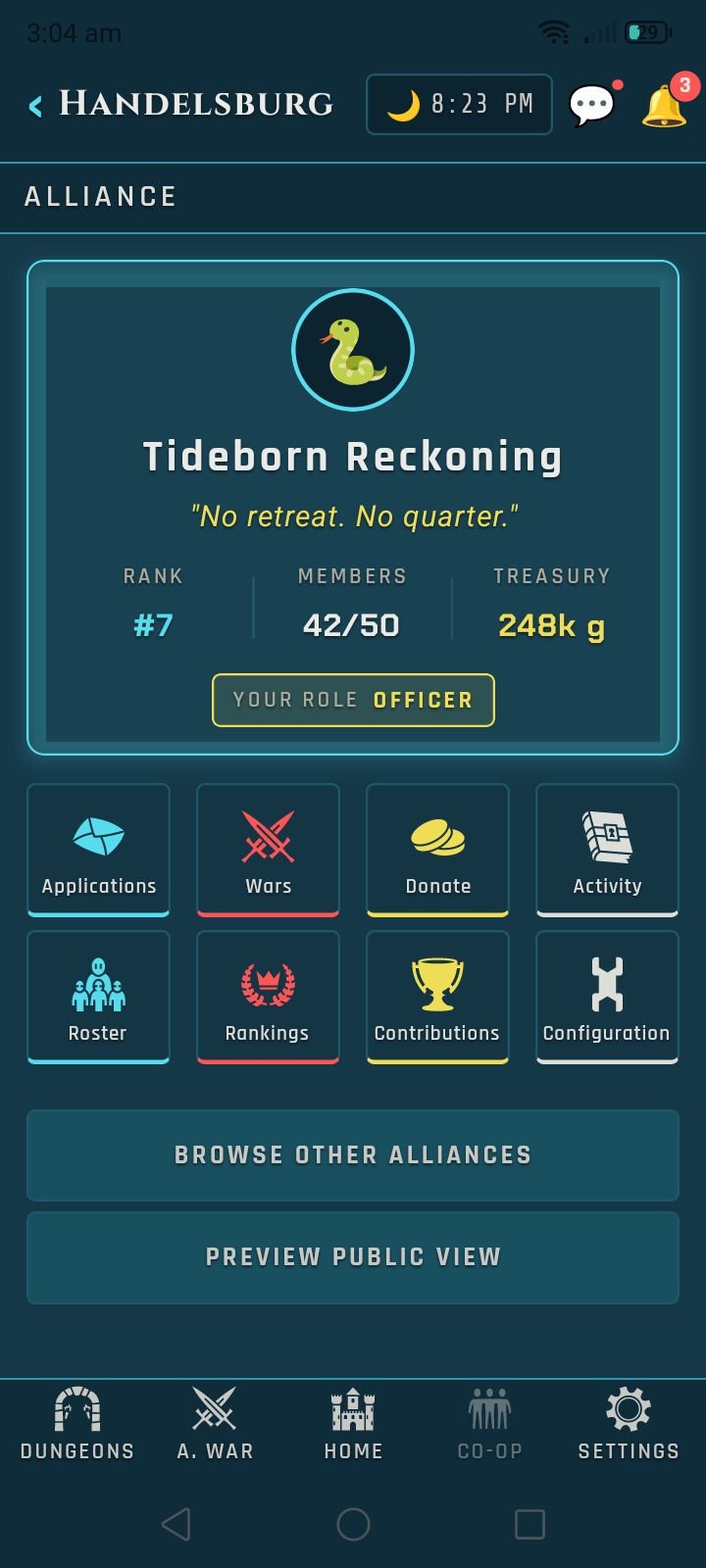
An Alliance is a persistent player group (up to 150 members at maximum rank) that progresses collectively across twenty ranks. Higher rank means more members allowed, larger bonuses on every member's runs, and access to the upper end of the territory ladder. Reaching Rank 20 is a multi-year achievement; a high-rank Alliance is the visible record of years of coordinated play.
Creating and joining
Any Level 20+ character can create an Alliance for 10,000 gold from their personal balance. Any character of any level can join an existing one. Alliances offer three join modes: Open (anyone walks in), Application (Leader or Officer reviews requests), or Invite-Only (Leader/Officer-issued invitations only).
Two-gate rank progression
Ranking up is collective. Each rank requires two gates met in sequence:
- Gate 1: Collective dungeon runs. Every member's completed deployment (Assault, Infiltrate, or Ghost) counts toward a shared threshold. When the threshold is reached, Gate 2 unlocks.
- Gate 2: Treasury gold. Any Member-rank-or-above character can donate personal gold to the Alliance treasury. When the treasury hits the required amount, the rank-up fires automatically. Treasury gold is one-way: donated gold is consumed on the rank-up and the treasury resets to zero. There is no withdraw, no balance between rank-ups, no bank.
The Rank 1 → 20 climb is calibrated to take a consistently active founding membership roughly six years. Early ranks are achievable in weeks; the late ranks are an endgame project.
Member cap and Officer slots by rank
| Rank | Member Cap | Max Officers |
|---|---|---|
| 1 | 50 | 3 |
| 5 | 70 | 5 |
| 10 | 95 | 7 |
| 15 | 120 | 10 |
| 20 | 150 | 10 |
(Member cap grows by +5 per rank, with +10 at the final rank. Officer slots grow on a slower curve and cap at 10.)
Bonuses (when running held territory)
| Rank | Gold Bonus | Mastery EXP | Skillset EXP |
|---|---|---|---|
| 1 | +20% | n/a | n/a |
| 5 | +26% | n/a | n/a |
| 10 | +34% | +20% | +20% |
| 15 | +42% | +35% | +35% |
| 20 | +50% | +50% | +50% |
Bonuses apply only on dungeon runs in stages the Alliance currently holds, or stages below the held one. No held territory means no bonuses; the social system is locked to the competitive one. Alliance bonuses stack additively with all other bonus sources (potions, equipment, Premium Subscription).
Roles
| Role | Count | Key Permissions |
|---|---|---|
| Leader | 1 | All actions |
| Officer | Up to per-rank cap | Invite, kick, promote below their rank |
| Member | Unlimited within cap | Donate to treasury, all activities |
| Recruit | Unlimited within cap | All Member permissions except treasury donations and being placed as a defender |
The Leader is one person; succession is governed by transfer rules. An automatic stand-in protocol promotes an Officer to act on the Leader's behalf when the Leader is offline during a war and a Leader-only war action is required.
Alliance Wars
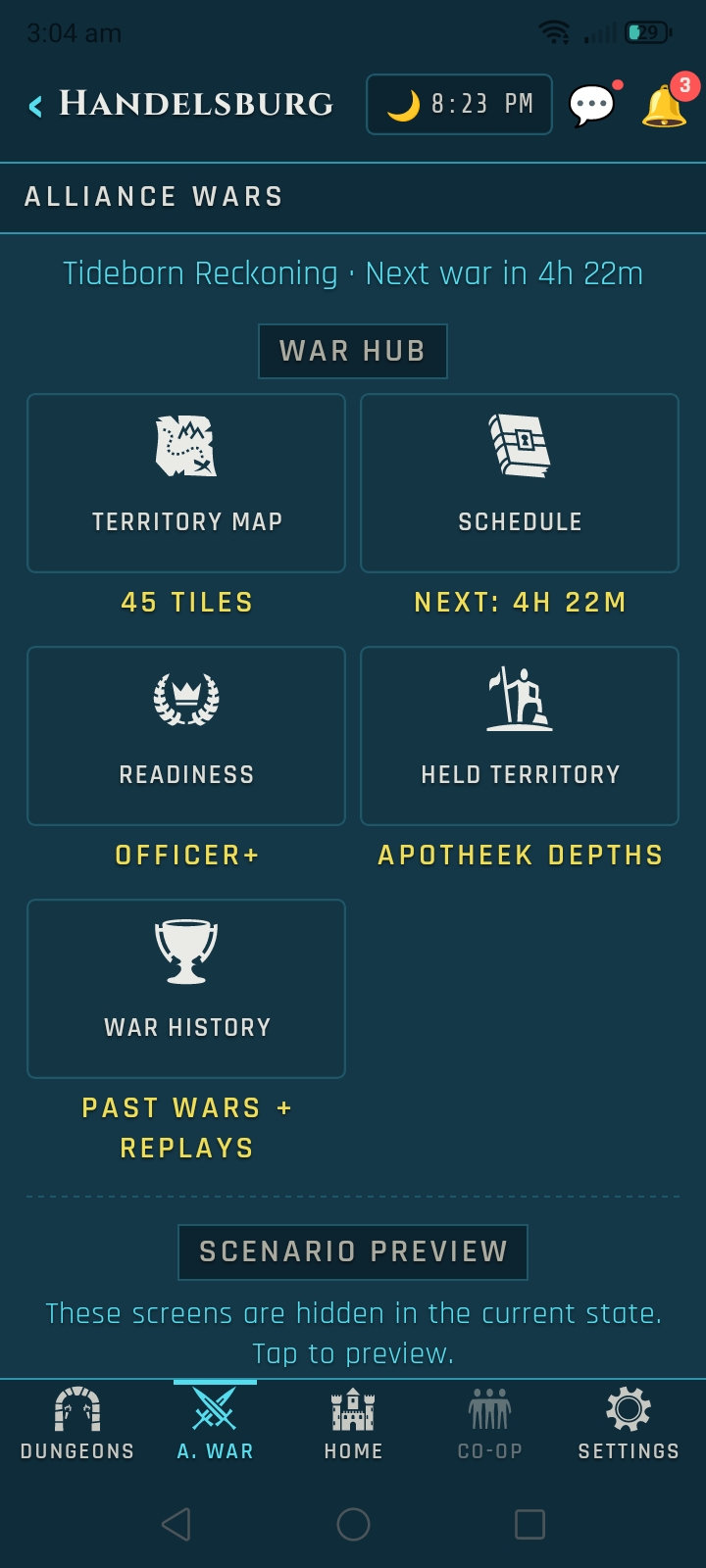
Alliance Wars is the game's scheduled group PvP layer: the competitive thing that gives Alliance bonuses something to fight over. Every contestable dungeon (every dungeon at Stage 7 through Stage 51) is a territory. An Alliance holding a territory at Stage N has its bonuses active for every member running every stage from 1 through N. Hold Stage 33 and the bonuses cover Stages 1-33. Hold Stage 51 and they cover the entire 51-stage ladder. An Alliance can hold a maximum of one territory at a time.
The schedule
Wars run on a fixed weekly cadence, not on demand:
| Day | Wars (Eastern Time) |
|---|---|
| Wednesday | 12:00 PM ET, 7:00 PM ET |
| Friday | 12:00 PM ET, 7:00 PM ET |
| Saturday | 12:00 PM ET, 7:00 PM ET |
Six wars per week. One hour each. Outside the war windows, no war combat occurs at all. The territory stays held until the next window, and the planning happens between them.
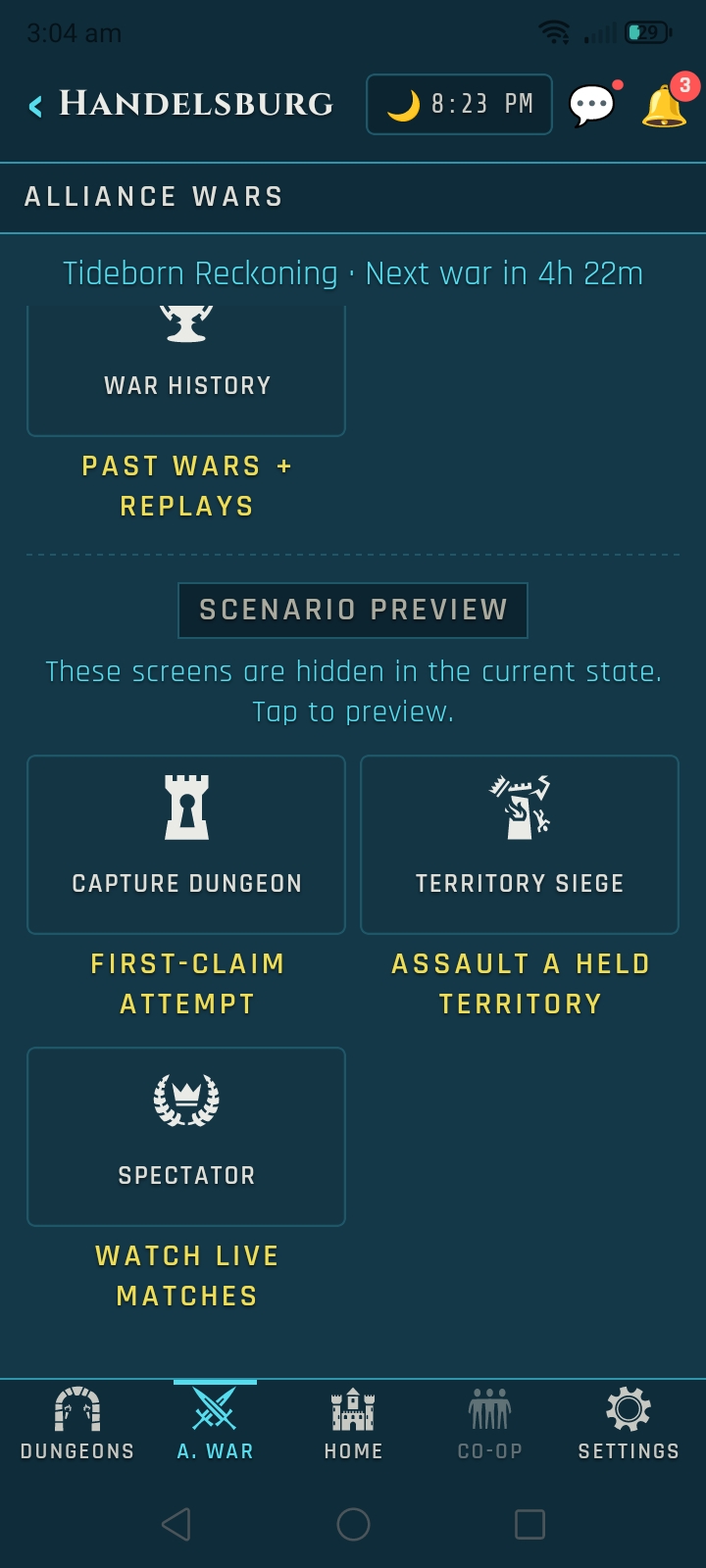
Two combat scenarios
| Scenario | Trigger | Mechanic |
|---|---|---|
| First Claim | Dungeon is unclaimed | Any Alliance can claim it by clearing the dungeon (no potions, no shortcuts). The first Alliance whose member clears it wins the territory. |
| Assault | Dungeon is held by another Alliance | Other Alliances assault the territory via 1v1 combat against placed defenders. To take the territory, every defender across all three tiers must be cleared within a single one-hour war window. |
The nine-member floor
To engage in any Alliance Wars combat (first-claim, assault, or defense), an Alliance needs at least nine war-eligible members for the dungeon's level range. Below that floor, the Alliance cannot start a war combat. If an Alliance drops below nine mid-war (members leaving, levelling out of range, opting out), its current war activity auto-resolves: held territories revert; assaults auto-fail; first-claim runs lose claim eligibility.
The floor matches the structural minimum: nine is the smallest defender roster the system will field, because the defender list splits into three tiers and each tier requires at least three slots.
Three-tier defender placement
When an Alliance claims a territory, a five-minute placement immortality window opens. The new holder cannot be assaulted while the window is active. During that window, the Leader (and Officers, on stand-in authority) place defenders into specific tier slots. Defender slot count for a territory equals the dungeon's Total Kills value. Stage 7 has 13 slots, Stage 33 has 141 slots, Stage 51 has 200 slots.
Those slots split across three tiers:
| Tier | Position | Combat Role |
|---|---|---|
| Vanguard | First (fights first) | Front line. Attackers must clear all Vanguard defenders before any Main Battle defender becomes selectable. |
| Main Battle | Middle | Centre mass. Assaultable only after Vanguard is cleared. |
| Rearguard | Last (final wall) | Anchor. Assaultable only after Main Battle is cleared. |
The Leader allocates the slot count between tiers (each tier at least three slots; the rest is strategic), then assigns defenders into tier slots. Defenders fight using the loadout they last logged with. Offline members can be placed and they will defend with their stored stats. Tier allocation can be rebalanced between wars (Pre-War Prep), but locks the moment the next war opens.
Assault rules
Attackers come at the territory through the tiers in order. They cannot select a Main Battle defender until they have cleared every Vanguard defender in their progression; they cannot select a Rearguard defender until they have cleared every Main Battle defender. To take the territory, the attacking Alliance must clear all three tiers within a single one-hour war.
Combat is potion-free, fatigue-free, and recovery-timer-free. HP and MP fully restore between matches. The win is decided by build, equipment, and play, not by who has the deeper consumable stockpile.
Eligibility caps power creep
A character cannot attempt to claim or assault a dungeon if their character level is above the dungeon's level range. A Level 80 character cannot bulldoze Stage 7 territory for their Alliance. The same rule applies to defenders: an overlevelled defender cannot be placed. Low-stage territories therefore have a natural shelf life: as an Alliance's members level past a dungeon's range, the war-eligible count for that dungeon falls, and eventually the nine-member floor breaks. Territory rotation is built into the design.
Per-war Mastery buff
Each tier rolls its own per-war Mastery buff. Holders see all three at the end of the previous war and can shuffle placement (between wars) to put their best operatives of the buffed mastery into the matching tier. Attackers reveal the buffs progressively: Vanguard's buff at war start, Main Battle's once Vanguard clears, Rearguard's once Main Battle clears. The buff turns each tier into a small puzzle the attacker has to solve while the holder gets to plan their defence around it.
Watching the war live
Both the active-attack screen and the held-territory screen expose a Watch live matches view. Alliance members can spectate their Alliance's in-progress 1v1 matches in real time (with a small server-side buffer to prevent exploit timing). Spectator mode is read-only (combat is still server-authoritative) and uses the same deterministic replay infrastructure that records every match for post-war review.
The Colosseum
The Colosseum is the casual 1v1 PvP venue: the on-demand counterpart to Alliance Wars' scheduled group PvP. One character against one character, on a 10×10 hex arena, resolved by the same combat engine that runs every PvE deployment and every Alliance Wars match. Unlocks at character level 5.
One combat contract
There are no PvP-specific damage caps, no healing reductions, no separate status-duration tables, no special PvP balance pass. Your PvE build is your PvP build. Whatever the math does in a dungeon, it does in the Colosseum. The same is true of Alliance Wars 1v1 matches; PvE, AW, and the Colosseum all share one combat resolver.
Idle and server-authoritative
Players do not take live actions during a Colosseum match. When both characters enter the arena, their loadouts are snapshotted at that moment, the server-side combat engine resolves the fight end-to-end, and the resulting combat log streams back to both players. Your skill is in how you build, equip, and configure the character, not in real-time button-mashing. This matches the project-wide combat model: every fight in the game is server-authoritative.
Bracketed by character level
Five brackets gate matchmaking so a Level 80 operative cannot face a Level 5:
| Bracket | Character Levels |
|---|---|
| 1 | 1 – 20 |
| 2 | 21 – 40 |
| 3 | 41 – 60 |
| 4 | 61 – 80 |
| 5 | 81 – 100 |
Bracket is derived from character level at the moment a room is hosted, joined, or listed. Levelling across a bracket boundary automatically moves you to the next bracket; rooms in the old bracket are no longer visible.
Self-opt-in only
No one can place you in PvP. You enter the Colosseum exclusively by hosting or joining a room. Offline characters cannot be challenged. This is the deliberate difference from Alliance Wars, where the Alliance Leader can place members as defenders; in the Colosseum, every match is opt-in by both sides.
No fatigue, no consumables
Colosseum combat does not deduct from the dungeon fatigue pool, so a character can run as many matches as they have time for. Like Alliance Wars combat, no potions or consumables may be used during a Colosseum match. Outcomes reflect build, equipment, and play, not stockpile spend.
Launch scope
The launch surface is one mode (1v1 Arena), Custom Rooms (host or browse), and a per-character match-history archive stored locally on the device. The launch goal is to harden the underlying combat contract (the same one Alliance Wars uses) before scaffolding the competitive systems on top of it.
The following are committed post-launch additions, in roughly this order:
- Win Rate (WR) and a six-tier ladder (Iron, Bronze, Silver, Gold, Platinum, Diamond) with concrete WR thresholds for each promotion. Bracket 5 (Levels 81-100) will eventually carry sub-divisions (Diamond III, II, I, Elite) for finer competitive segmentation.
- Seasons with end-of-season rewards based on peak WR tier achieved, and a WR reset to the tier floor at season end.
- Tournament Mode, with 5-round Swiss-format events that carry WR multipliers and rewards.
- 4v4 Team Fight, with random queue and pre-made lobbies.
- Quick Match for 1v1 (the launch version is hosted Custom Rooms only).
- Leaderboards: overall, per-bracket, and per-Alliance.
- Live Spectator Mode with a small delay.
None of these are vapourware. Every one of them was specified in the original Colosseum design and exists as a deferred section in the canonical TDD; the launch version surfaces the ladder structure that will eventually carry them.
Together, the four layers turn a solo MMORPG into one with persistent group identity, scheduled group PvP, on-demand 1v1 PvP, and a co-op tier that runs the harder catalogue. Co-op is the headline post-launch addition; everything else is committed to the launch build.